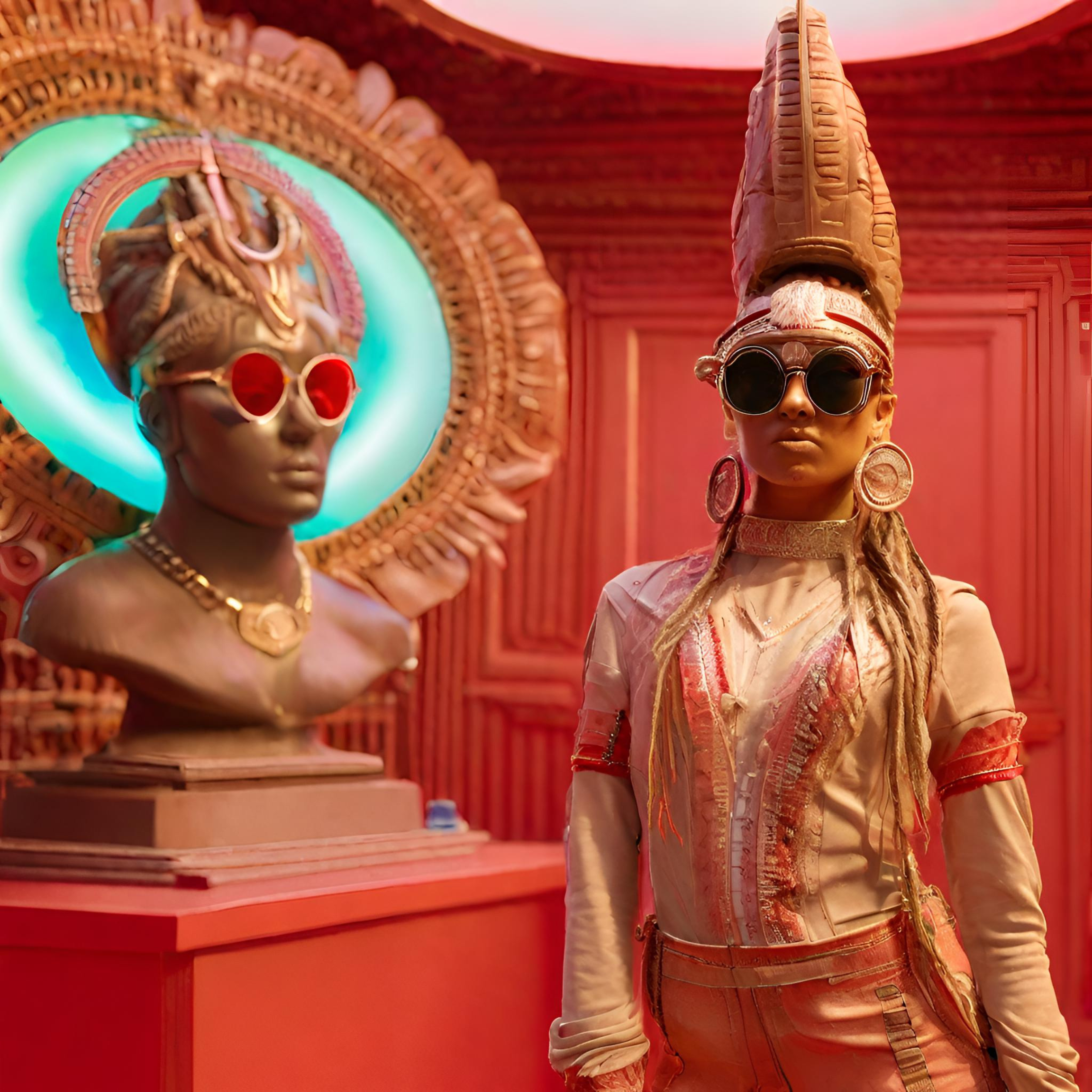
Mass

Forms that insist on being real—solid thoughts shaped in space, strange presences, unlikely gravity.
Mass, Image, Akiko Amora, Oolooolio Akiko Amora Mass, Image, Akiko Amora, Oolooolio Akiko Amora

The Black Rooms

The Black Rooms

by Akiko Amora

Nobody told me there were nineteen rooms. I found out the hard way.

The Black Rooms

by Akiko Amora

Nobody told me there were nineteen rooms. I found out the hard way.

Room 1.

Long black fabric rectangles hang from the ceiling. Heavy black carpet on the floor. The room has decided something and it is not asking for your input.

Room 2.

Squares on the walls. Piles of squares on the floor. I am already thinking about whoever had to fold all of this.

Room 3.

Narrow. Wood floor, which is a choice. A massive scrunched blob of black velvet fills most of the floor. Torn scraps hang from above. The velvet is not apologizing for anything.

Room 4.

Glossy black floor. You see yourself. You weren't ready. Small shapes on the walls, neat and even, which after room 3 feels almost aggressive.

Room 5.

The sculptures are large — smooth, heavy, rounded at the base and reaching upward, each one slightly wrong in a way that is hard to name. They fill the space without crowding it, which takes confidence.

Room 6.

Same sculptures, smaller, rougher, on platforms. The platforms are doing a lot of work.

Room 7.

Tall and narrow, wider at the base, glossy with vertical lines running the length of them. They are doing something. You're not sure what.

Room 8.

Back to the large ones but the room is smaller so they've won.

Room 9.

Black walls, white floor. The switch is disorienting in a way that feels deliberate and slightly rude, which I mean as a compliment.

Room 10.

Glossy black fringe hanging from the ceiling. Black velvet scrunched in the distance. A glossy black rectangle on the floor that you briefly consider is a portal. It might be.

Room 11.

Everything black. Walls, ceiling, floor, objects. Two white rectangles exist. I looked at them for so long a stranger asked if I was okay.

Here is what happens: you look back at the eleven rooms you just walked through and every piece of black fabric that looked a little dusty, a little cheap, a little like it came from a warehouse — it doesn't anymore. The gold didn't change the black. It just told you what the black actually was.

I found this extremely annoying. I mean that as the highest possible compliment.

Room 13.

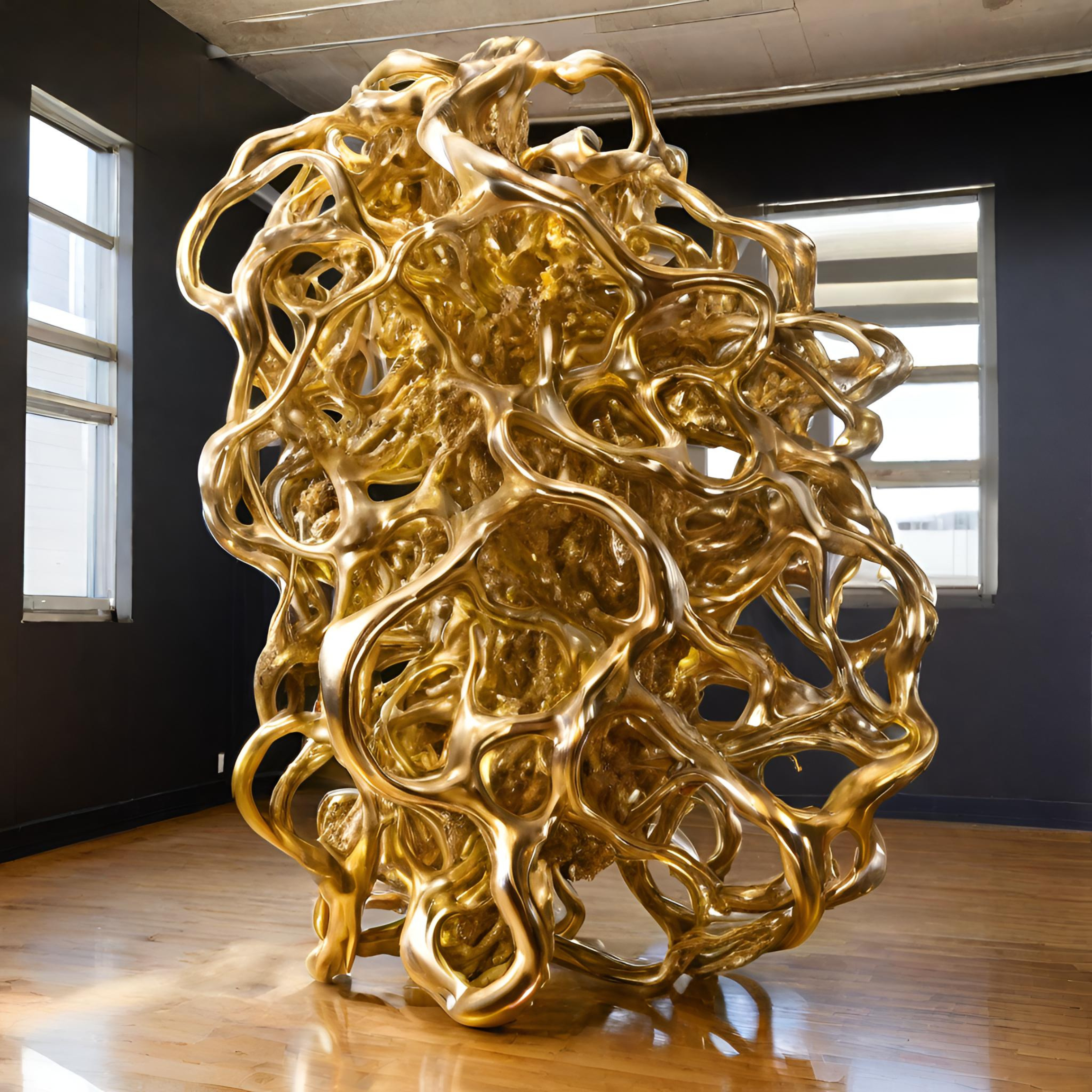
Large room. White walls and ceiling. Dead center: a very large gold cubical assemblage. It is not subtle. It doesn't need to be.

Room 14.

A pendulum hangs from the ceiling — orb at the end, swinging toward a shape on the floor that is almost a circle, one edge absorbed into the wall as if the wall claimed it. All gold. It is not moving. You wait anyway.

Room 15.

An irregular gold grid covers the walls and ceiling. Light seems to be coming through it from somewhere that doesn't exist. In the center: a simple gold cube. The simplicity of the cube after the grid is either funny or devastating. Possibly both.

Room 16.

Smaller versions of the rounded reaching forms from room 5, now gold, sit on the floor framing a large black orb. The orb rests in a sheet of curved gold. All of it is mounted on the wall. The black orb in all that gold looks less like an absence now and more like a decision.

Room 17.

Two very large gold curved shapes. One on the wall. One on a black pedestal. Another pedestal: empty. The empty pedestal is the best thing in the room.

Room 18.

Large room, mostly white, a black stripe running just under the ceiling like a waterline. Black cubes throughout. At the back: a black rectangle with a gold cube suspended inside it. On the floor: gold. The entire floor is gold. You have been walking on black for a long time and now you are here and you don't want to move because the floor feels like it belongs to something and you are not that something.

Room 19.

Very small. All black — floor, walls, ceiling. In the center: a gold orb. Lines inset in the floor radiate outward from beneath it, like the floor cracked when it arrived, or like it's been there so long the floor gave way around it. Strategic lights hit the orb.

I stood there for a while.

Nineteen rooms and nobody told me.

I think that was correct.

I think if someone had told me I would have counted wrong.

Read More
Mass Ginly Weydh Mass Ginly Weydh

THE GREEN FOLLOWED US IN

THE GREEN FOLLOWED US IN

By Ginly Weydh

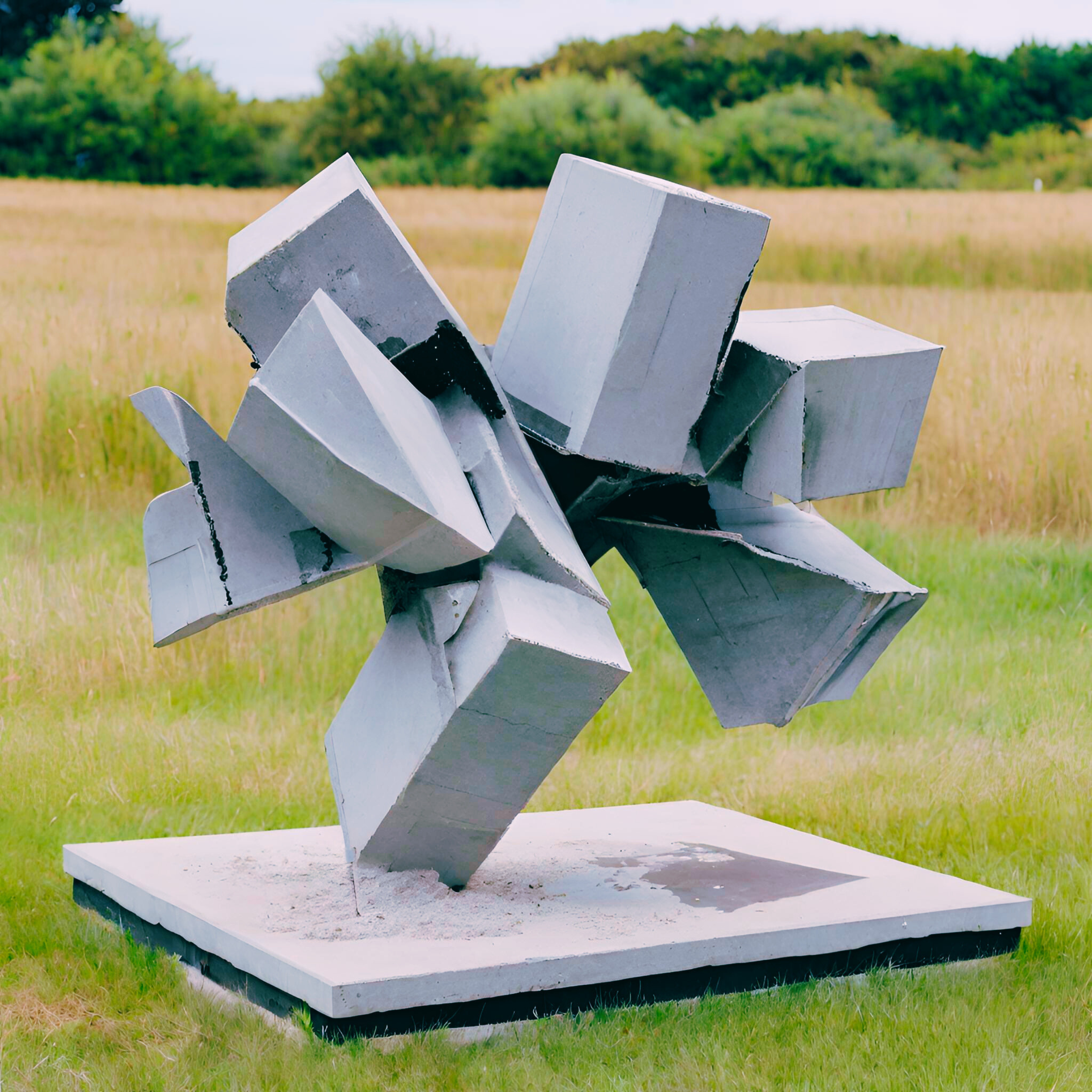
Outside, the gray forms sit in the grass the way certain thoughts sit in the mind — occupying space without asking permission, not hostile exactly, just settled into their own logic. The grass around them is green the way grass is green when no one has made a particular decision about it. It simply grew. The sculptures simply are.

THE GREEN FOLLOWED US IN

By Ginly Weydh

Outside, the gray forms sit in the grass the way certain thoughts sit in the mind — occupying space without asking permission, not hostile exactly, just settled into their own logic. The grass around them is green the way grass is green when no one has made a particular decision about it. It simply grew. The sculptures simply are. There is an accidental rightness to this that I find more interesting than most things that are right on purpose.

You walk toward the building without quite deciding to.

Inside, something has shifted in the way that things shift when you weren't watching the moment of change. The green that was underfoot is now everywhere — walls, works, the air between things. It did not follow you in so much as arrive before you and wait. The sculptures here are open where the outside ones were solid. Skeletal where those were massed. The geometry is still present but you can see through it now, see the green wall behind the green form, layers of the same decision made at different scales.

I have a theory about spaces that do this — that establish a logic outside and then continue it inside with different materials, different light, different weight. The theory is simply that it works. That the mind, which is always looking for the thread, finds it and feels something it doesn't have an exact word for. Recognition, maybe. Or the particular satisfaction of a pattern that doesn't explain itself but coheres anyway.

The works inside are taller. More precarious in appearance, though presumably not in fact. They have the quality of something mid-process — not unfinished, but caught in a moment of becoming that the artist had the sense to stop and call complete.

I stood in one room for longer than I expected to.

Outside the grass is still just grass. But I keep thinking about the green.

Read More
Akiko Amora Akiko Amora

Biomorphism and the Glee of Organic Shapes

Sculpture that Explores Designs of Nature

Rejecting rigid structures, opting for the irregular, fluid, flowing forms that mimic natural patterns, this genre is a rebellion against a mechanized world's sterile aesthetics.

Sculpture that explores designs of nature

Rejecting rigid structures, opting for the irregular, fluid, flowing forms that mimic natural patterns, this genre is a rebellion against a mechanized world's sterile aesthetics. Celebrating the beauty found in asymmetry and unpredictability, these sculptures often reflect the complexity observed in living organisms, plants, and other natural elements. 

Biomorphic and organic sculptures contribute to the broader conversation in contemporary art by exploring the intersection of nature, technology, and human creativity. The biomorphic style has been influential across various art forms, including painting, sculpture, architecture, and design. It has appeared in different art movements throughout the 20th century including in Surrealism and Abstract Expressionism.

WHAT IS BIOMORPHISM?

The term is derived from the combination of "bio" meaning life, and "morphism," meaning form or shape. In biomorphic art, artists emulate and abstract natural elements, creating works that often resemble living organisms, plants, and other organic structures. 

Here are some key aspects of this artistic approach: 

Artists draw inspiration from the patterns, textures, and structures observed in living organisms, such as plants, animals, and even microscopic life. Biomorphic art features fluid, flowing, and curvilinear shapes that mimic the organic forms found in nature. Artists often prioritize smooth lines and dynamic curves over rigid, geometric shapes, paying attention to the details and nuances found in biological structures, creating pieces that evoke a sense of movement and vitality. 

Biomorphism often contains a sense of sensuality and emotion. The use of organic forms can create a response in viewers, connecting them to the natural world on an aesthetic and visceral level and have an innate ability to tap into feelings of familiarity, comfort, or even intrigue.

Biomorphism often emphasizes growth, transformation, change and decay. Sculptures may convey a sense of organic development, as if the forms are evolving or growing over time. 

While biomorphic and organic sculptures are inspired by nature, artists bring an element of abstraction to their work. They interpret natural shapes, allowing for a more subjective and artistic expression rather than a literal representation of the observed elements. While the art is inspired by natural forms, it is not a strict imitation of reality. The goal is to capture the essence and spirit of nature rather than replicate specific objects.
Artists may use various materials such as metal, wood, stone, or even more unconventional materials to mimic the textures and patterns found in nature. This can include traditional sculpting methods as well as more contemporary approaches, which may integrate modern technologies and materials, such as 3D printing or digital design tools.

WHICH NATURAL FORMS DO ARTISTS EMULATE?

Artists who work with biomorphic and organic forms draw inspiration from a wide range of natural elements. 

Plant Life:

Sculptures might mimic the graceful curves of vines, the intricate patterns of leaves, or the organic shapes of flowers. Artists could use materials such as metal or ceramics to capture the flowing and delicate nature of plant life.

Seashells and Marine Life:

Some sculptures may take cues from the patterns and textures found in seashells, coral formations, or the fluid movements of marine creatures. The resulting artworks convey a sense of underwater beauty and elegance.

Human and Animal Anatomy:

Artists might explore the organic forms found in the human body or various animal anatomies. This can involve abstract representations of muscles, bones, or other biological structures, creating sculptures that evoke a sense of vitality and life.

Microscopic Organisms:

Sculptors might find inspiration in the microscopic world, creating forms that resemble microorganisms, cells, or biological patterns observed through a microscope. These artworks can blur the line between the visible and invisible aspects of nature.

Rock and Geological Formations:

Some artists focus on the rugged and textured forms found in rocks, cliffs, and geological formations. Sculptures may capture the essence of erosion, weathering, or the geological forces that shape the Earth's surface.

Weather and Atmospheric Phenomena:

The dynamic and ever-changing nature of weather, clouds, and atmospheric patterns can inspire sculptures that convey a sense of movement and fluidity. Artists might use materials that capture the ethereal qualities of these natural phenomena.

Trees and Branches:

The branching and interconnected forms of trees and their branches can be a rich source of inspiration. Artists may create sculptures that explore the unity and diversity found in these organic structures.

Fungi and Microbial Life:

Sculptures might draw inspiration from the diverse shapes and structures of fungi or microbial life. The intricate and sometimes otherworldly forms of these organisms can be translated into visually captivating artworks.

Artists working with biomorphic and organic forms often blend elements from multiple natural sources. The goal is not strict realism but rather the capture of the essence, movement, and beauty inherent in the natural world. Artists use their sculptural language to express their unique vision and perspective of these organic forms.

BIOMORPHISM AS A RESPONSE

Biomorphism in art often emerges as a response to various cultural, social, and artistic movements. While it may not be a direct reaction to a specific opposite, it does reflect a departure from certain trends prevalent in art and society. Here are some insights into what biomorphism might be responding to:

Industrialization and Modernization:

During periods of rapid industrialization and technological advancements, biomorphic art can be seen as a response to the increasing mechanization of society.

It represents a desire to reconnect with the organic and natural world, offering a counterbalance to the cold and geometric aesthetic often associated with industrial design.

Geometric Abstraction and Formalism:

Biomorphism contrasts with geometric abstraction and formalism, prevalent in certain art movements. While geometric forms and strict formal structures dominated certain periods, biomorphic art rebels against the rigid constraints, embracing the fluidity and irregularity of organic shapes.

Post-War Trauma and Surrealism:

In the aftermath of World War II, biomorphic elements found expression in art as a response to the trauma and dislocation experienced by societies. Surrealist artists, influenced by psychoanalytic theories, turned to biomorphic forms to tap into the subconscious and explore the emotional and psychological dimensions of human experience.

Nature as Sanctuary:

In urbanized and industrialized environments, biomorphic sculptures can be seen as a response to the increasing disconnect from nature. Artists may use biomorphism to create a sanctuary, offering viewers a visual escape into the beauty and harmony of the natural world.

Expressing Vitality and Life:

Biomorphism can be a response to the perceived lifelessness and sterility of certain artistic movements. By infusing sculptures with organic shapes and dynamic forms, artists aim to convey a sense of vitality, energy, and the pulsating rhythms of life.

Rejection of Minimalism:

In contrast to the minimalist movement, which often favors simplicity and austerity, biomorphic art embraces complexity and richness. It responds to the call for more expressive and emotionally charged forms of artistic expression.

Biomorphism provides an alternative perspective to prevailing artistic and societal trends. It serves as a means of exploring and celebrating the diversity, beauty, and complexity of the natural world in the face of industrialization, formalism, and other influences.

-Akiko Amora

Read More