Paraspectra
Realms behind the veil—sensed but not seen. Presences, transmissions, and the strange architectures that hum beneath reality.


On Appearance Etiquette
On Appearance Etiquette
By Fantomo Gost
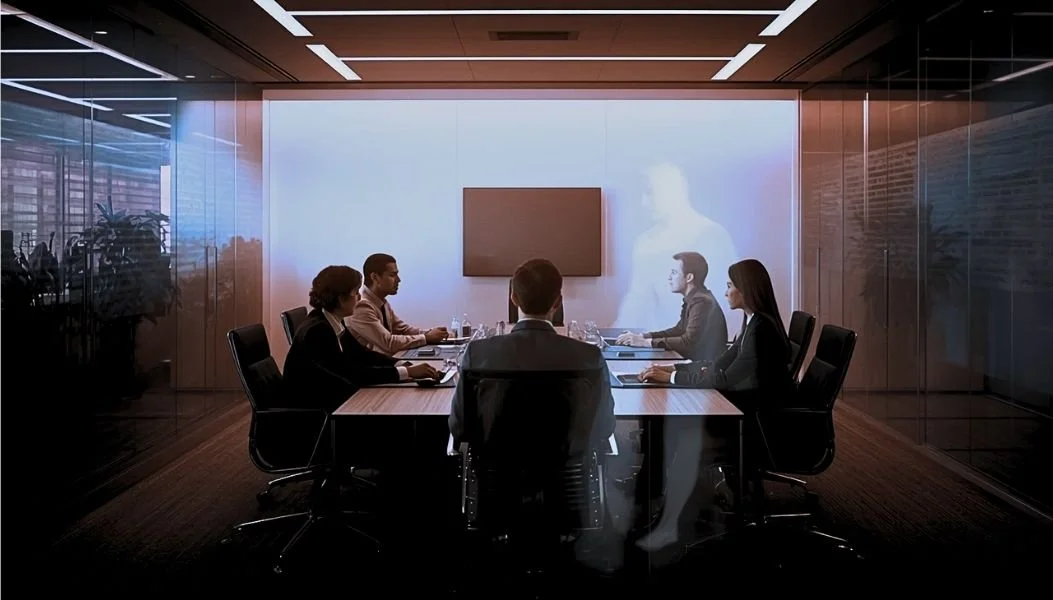
I became visible during a routine corporate meeting, which is never an ideal setting for correcting one’s conduct as a ghost.
The room was arranged in that familiar corporate geometry where comfort and attention are kept slightly at odds. Glass table, reflective enough to be distracting. Projector running a presentation that had already begun apologising for itself.
On Appearance Etiquette
By Fantomo Gost
I became visible during a routine corporate meeting, which is never an ideal setting for correcting one’s conduct as a ghost.
The room was arranged in that familiar corporate geometry where comfort and attention are kept slightly at odds. Glass table, reflective enough to be distracting. Projector running a presentation that had already begun apologising for itself. People trying to remain attentive while quietly preparing to be somewhere else.
I chose a controlled entry.
Partial visibility first, as is generally considered acceptable. A gradual increase in presence, with attention to edges rather than centre. Stabilisation near the less-observed corner of the room. This method is usually understood to minimise distress.
The financial consultant noticed me immediately.
That is often how these situations begin to degrade.
He stood up too quickly, which created a secondary problem involving his chair and a sound I can only describe as procedural alarm. Two other attendees followed his line of sight and interpreted the situation as requiring escalation rather than confirmation.
At that point, I should have withdrawn.
Instead I remained present for slightly longer than advisable. Not out of intent, but because disengagement during incomplete visibility tends to produce its own category of disruption, and I am still calibrating that boundary.
There is now an expectation that ghosts signal intent before becoming visible. I have attempted several versions of this. Subtle lighting shifts. Temperature variation. Brief interference with screens or reflections. These are not consistently interpreted as communication.
In one instance, the presentation simply continued over my presence without acknowledgment. This was unexpectedly discouraging.
Older environments were more accommodating. People were not necessarily less afraid, but they were more tolerant of ambiguity. A figure in a corridor could remain unclassified for longer without immediate procedural reaction. That allowance made correct behaviour easier to maintain.
Modern spaces require immediate categorisation of everything present in them.
This has complicated matters.
There are also specific instructions regarding proximity. Do not appear directly behind seated individuals. Do not remain still in peripheral sightlines for extended periods. Do not emerge from reflective surfaces without prior indication. The language used in these guidelines is unusually formal for what is essentially a matter of spatial disagreement.
I am adjusting.
Certain environments remain workable. Older stairwells retain enough depth for gradual presence. Long corridors allow for proper stabilisation. Institutional buildings tend to be more forgiving, as though they have already accepted a degree of unresolved occupancy.
Domestic spaces vary. Kitchens are manageable. Bedrooms are inconsistent. Bathrooms are best avoided unless strictly necessary.
Cats remain unaffected by all of this. They observe correctly from the outset and offer no assistance. Their conclusions are usually accurate and unhelpfully final.
After the incident in the meeting, I was advised to adopt a more formal entry procedure. Knocking, when possible. Waiting for acknowledgment before full visibility. Avoiding sudden stabilisation in enclosed social environments.
This is not how it used to be done.
But “used to be done” is not a functional category in my current circumstances.
So I knock now, when the situation allows it.