WHAT THE BODY KNEW BEFORE ANYONE ASKED



WHAT THE BODY KNEW BEFORE ANYONE ASKED
By Suchu Tanyetz
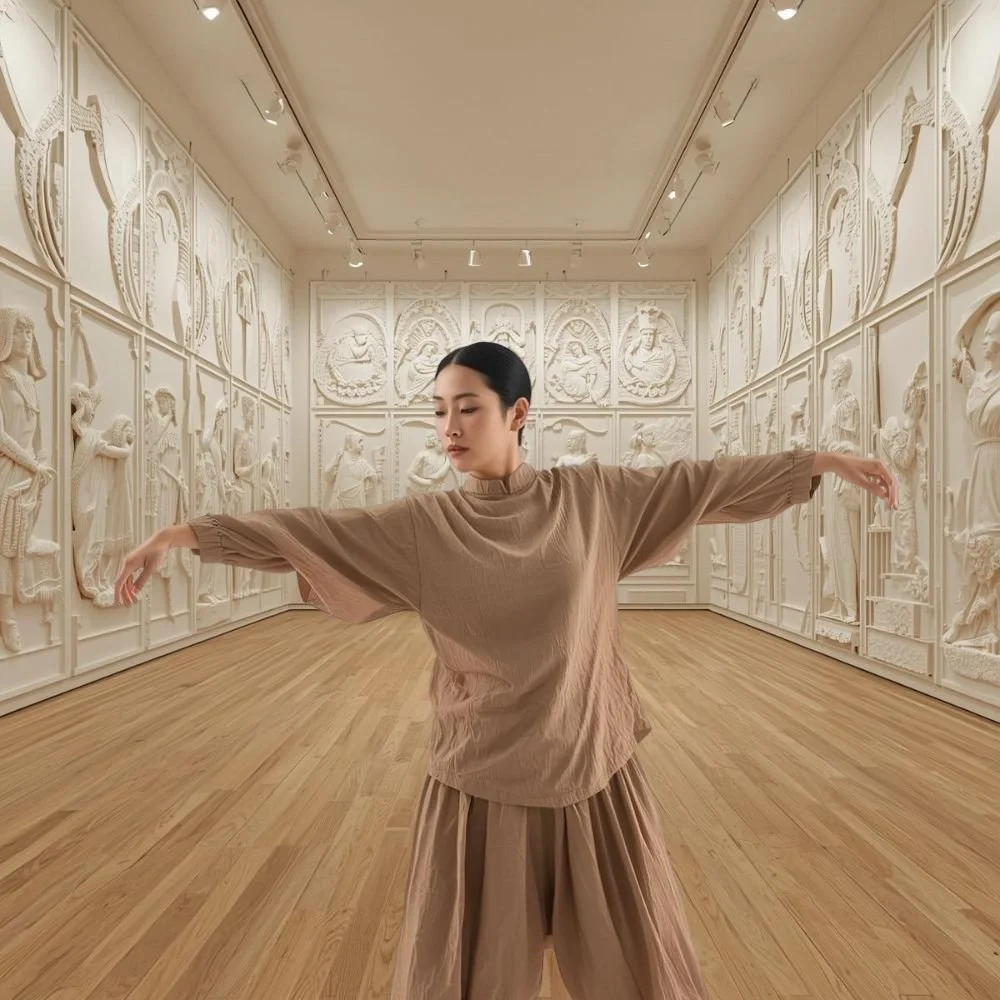
There is a particular kind of body that moves through early life with what everyone around it calls natural ability. It folds easily. It reaches further than expected. It recovers from positions that would trouble other bodies and does so without drama. Teachers notice. Choreographers notice. The body itself does not notice, because it has no basis for comparison. This is simply what moving feels like.
What no one mentions — what no one in any room I was ever in thought to mention — is that this quality has a structural explanation. That the tissue holding everything together is operating outside standard parameters. That the flexibility is not a gift exactly, or not only a gift. It is a characteristic. A specific one, with a specific logic, and eventually, specific consequences.
I did not know this for a long time. Neither did anyone who worked with my body professionally, and several of them were paid specifically to understand bodies.
What dance gave me, without naming it, was a daily practice that happened to manage the condition perfectly. Warmup. Cooldown. Constant proprioceptive attention — the ongoing low-level question of where is my body in space, what is it doing, is that joint where it should be. Strength work that was never called strength work because it was called choreography. The muscles, developed over years of this, were doing the work that the connective tissue was not fully equipped to do on its own. The scaffolding held. I did not know the scaffolding was necessary because I had never been without it.
Then at some point the daily practice changed. The scaffolding came down gradually, the way things do, through accumulation of circumstance rather than any single decision. And the body, which had been quietly depending on that structure for decades, began to make itself known in new ways.
This is not a complaint. It is an observation about systems — how they compensate, how compensation can be so effective that the underlying condition remains invisible, how the removal of the compensating structure reveals what was always there.
Medicine, in my experience, is oriented toward the acute. The sudden, the measurable, the thing that shows up clearly on an image or a number. A body that has spent decades in sophisticated compensatory relationship with its own unusual architecture is not always legible to this approach. The knowledge I had accumulated — specific, longitudinal, granular — was frequently received as noise rather than data.
I found this interesting in a way that took some time to become interesting rather than simply enraging.
What I know now, that I did not know when I was moving through studios and stages without apparent difficulty, is that the body was always working harder than it looked. That what read as ease was actually a highly developed management system. That the joint that popped back without much fuss was still a joint that had moved beyond its range. That these things accumulate.
The body keeps its own records. It is worth learning to read them before someone else decides they know what the document says.