Tellings
Fiction, memoir, maybe neither. These are narrative-shaped things—stories, semi-stories, things that unfold, drift, or confess. Some are real, some aren’t. Most don’t say.



On the Occasion of a Retrospective
On the Occasion of a Retrospective
by Akiko Amora
The work is clean. I will say that first because it is true, and because I was trained — by necessity, by professional survival, by the long practice of saying difficult things inside polite containers — to lead with what is true before arriving at what is complicated.
ON THE OCCASION OF A RETROSPECTIVE
by Akiko Amora
The work is clean. I will say that first because it is true, and because I was trained — by necessity, by professional survival, by the long practice of saying difficult things inside polite containers — to lead with what is true before arriving at what is complicated. The complicated part, I have found, always takes longer than anticipated. This essay was due last month. I am noting that here not as apology but as data.
The retrospective is well-mounted. The catalog is substantial. One hundred and twelve pages, with full color plates and an introduction by someone whose opinion is considered, in certain circles, to matter enormously. I have a catalog. It is forty-two pages and I made it myself, in a year when making it myself was the point, when the catalog as institutional object was exactly what we were refusing, when legitimacy was the thing we were explicitly not asking for because we understood, or believed we understood, that legitimacy was where work went to become decorative. I printed it. I distributed it by hand. Several copies were stolen, which I considered a form of critical engagement. The pages are in the wrong order. This was intentional. It was received as a joke by people who didn't understand it and as a serious gesture by people who did and I have never been entirely sure which group was right and I have stopped trying to decide.
That catalog is now, I am told, a collectible.
I want to be clear that I am approaching this retrospective with genuine openness. I am a professional. I have been a professional for longer than some of the critics reviewing this show have been alive, and part of what professionalism means, in the arts, is that you do not say certain things publicly. The arts are already embattled. We do not eat our own. We show up to each other's openings and we say the work is strong and we mean it as much as we can and we go home and we make more work and we do not, under any circumstances, say what we are about to almost say and then redirect.
So. The work is clean.
The Artist — I will call them the Artist throughout, which is a courtesy I extend because the alternative involves a name, and the name would do things in this essay that I cannot afford and they would not notice — the Artist's practice, per the catalog introduction, boldly interrogates the dissolution of boundaries between disciplines, forging a new multidisciplinary language that contemporary practice is only beginning to catch up to.
I have been dissolving those boundaries since 1991.
I want to be precise about this because precision matters to me, has always mattered to me, even when — especially when — the work I was making was being described as unfocused, uncommitted, unable to decide what it was. Pick a lane, I was told, by people whose job it was to tell me things. Galleries don't know how to sell this. Grants committees don't know where to put you. You're making it very difficult for everyone. I was making it difficult. I was doing it on purpose. I believed, with the particular stubbornness of someone who has looked carefully at a problem and arrived at an inconvenient conclusion, that the lane itself was the limitation. That the form was the argument. That if you wanted to say something true about how experience actually works — layered, contradictory, embodied, multiple — you could not say it by staying in one room.
There are now graduate programs in multidisciplinary practice. I have been invited to speak at several of them. This is very gratifying.
I first encountered the Artist at a festival in — it doesn't matter where. I was running a workshop series on embodied spatial practice and interdisciplinary methodology, which at the time was considered niche enough that the festival had tucked it into a slot between lunch and something involving puppets. The Artist was twenty-three and looking for work and I gave them work because that is what you do when someone is twenty-three and serious and standing in front of you with the particular hunger of someone who wants to be in the room where things are happening. The work I gave them was not glamorous. It involved folding chairs, a laminator, a broken freight elevator, and one very long afternoon that I remember more clearly than they appear to.
I taught them how to invoice. I taught them how to write a grant narrative. I sat with them for two hours going over how to talk about multidisciplinary work to people who were suspicious of it, how to frame it, how to make the case. I gave them language. I want to be careful about how I say this. I am not saying they took anything. I am saying that I gave it freely and that this is what mentorship is and that the catalog is one hundred and twelve pages and does not mention this afternoon or any afternoon like it and I understand that retrospectives are not required to be archaeological and yet.
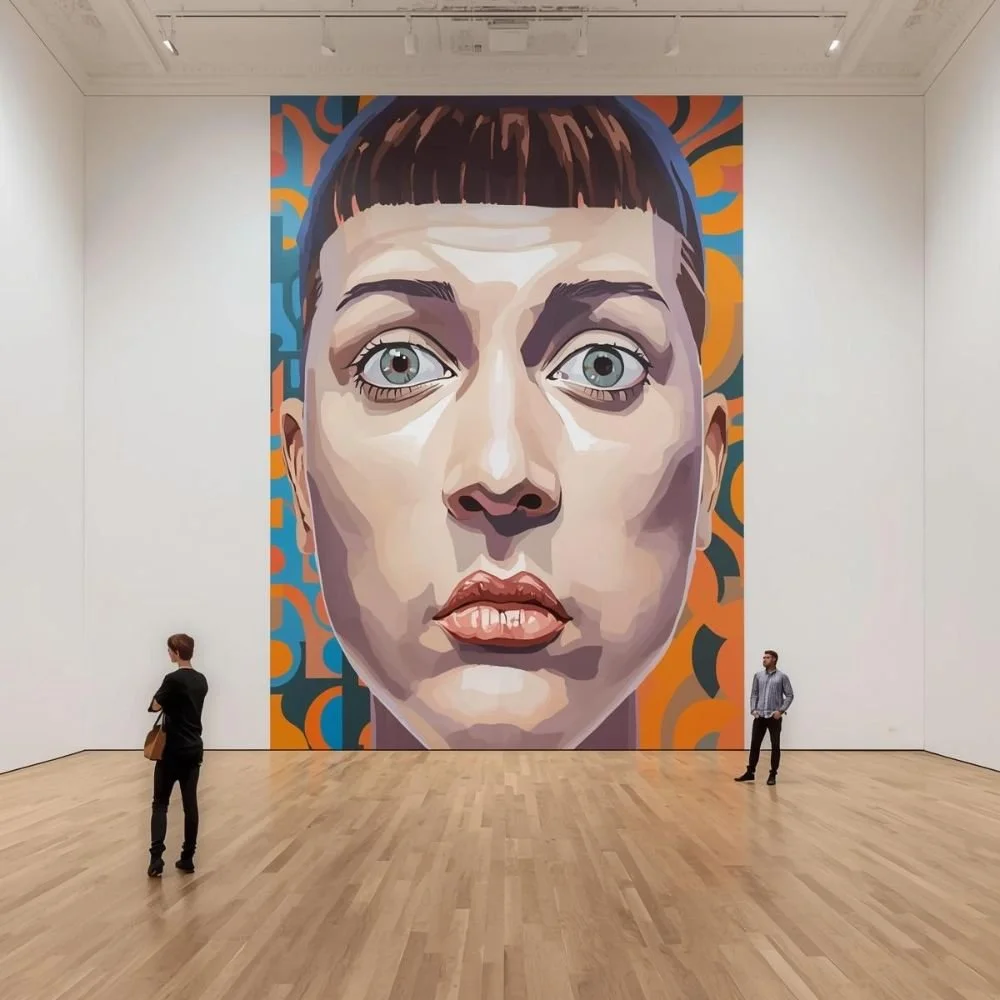


The work is clean, I keep returning to this, because it is the thing I can say without qualification. It is legible. It is well-made. It gives the viewer exactly what they came for and nothing that will disturb their sleep. In 1994 a critic wrote about my work that it was aggressively resistant to comfort and meant it as an insult and I kept the clipping because it seemed accurate. Comfort was never the point. The point was the thing that happens when form breaks open and something true falls out.
I am told the Artist's work is very influential right now.
I am told, by a person who meant well and has no idea what they said, that I should look at this work. That I would find it instructive. This person did not know — could not have known, I am being generous — that I was making this work before the Artist had language for it, that I handed the Artist their first professional foothold, that I sat with them in a freight elevator that wasn't moving and explained to them why the multidisciplinary impulse was not a failure of focus but a different kind of rigor. They did not know. People frequently do not know. This is, I have come to understand, not personal. It is structural. The structure does not keep records of who was in the room first. It keeps records of who has the catalog with the introduction by the right person.
I smiled in the way I have been practicing since approximately 1993.
The work is clean. The catalog is one hundred and twelve pages. I taught them how to invoice and I would do it again because that is what you do and because the alternative is a smaller world and I have never wanted a smaller world, only a more honest one.
I don't know why I keep coming back to the laminator.
It doesn't belong in this essay.
I am leaving it in.