Embodied
The self as sensed—movement, stillness, intuition, and the body as a way of thinking.







The Thought Arrives Late
THE THOUGHT ARRIVES LATE
By Suchu Tanyetz
There is a moment before a thought that does not look like thinking.
It is small. Easy to miss if you are waiting for language. A shift of weight that happens without instruction. A hand that stops or continues without explanation. Something in the chest that tightens or releases, and only afterward becomes a reason.
THE THOUGHT ARRIVES LATE
By Suchu Tanyetz
There is a moment before a thought that does not look like thinking.
It is small. Easy to miss if you are waiting for language. A shift of weight that happens without instruction. A hand that stops or continues without explanation. Something in the chest that tightens or releases, and only afterward becomes a reason.
I was taught — not directly, but thoroughly — that the thought comes first. That the body follows. That sensation is a kind of supporting material, useful if interpreted correctly.
This has not matched my experience.
What I notice instead is that the body is already in motion by the time I can describe what is happening. Not dramatically. Not in a way that announces itself. Just enough that the description feels like it is arriving late to something that has already been decided.
For example, I will reach for something and then realize I did not want it. Not in a metaphorical sense. The hand has already extended. The correction comes after. Or I will feel a resistance — a very slight one — to continuing with something I am doing, and if I override it, the cost appears later as a kind of collapse that seems disproportionate until I remember I was informed earlier.
None of this presents as an argument.
The body does not explain itself. It does not offer evidence. It does not wait to be agreed with. It proceeds, and if I am paying attention, I can sometimes notice that the proceeding happened before I understood it.
This makes the idea that thinking is located primarily in the brain difficult to maintain in a practical way.
Not because the brain is irrelevant. It is clearly very busy. It names, organizes, justifies. It is excellent at producing a coherent account of what is happening. But the account has a particular quality: it follows.
I can feel this most clearly in moments where I try to be certain.
If I attempt to decide something purely “in my head,” holding the body still as if it is not part of the process, the decision feels thin. It can be stated cleanly, but it does not hold. Something interrupts later — fatigue, irritation, a refusal that appears without language — and I have to revise.
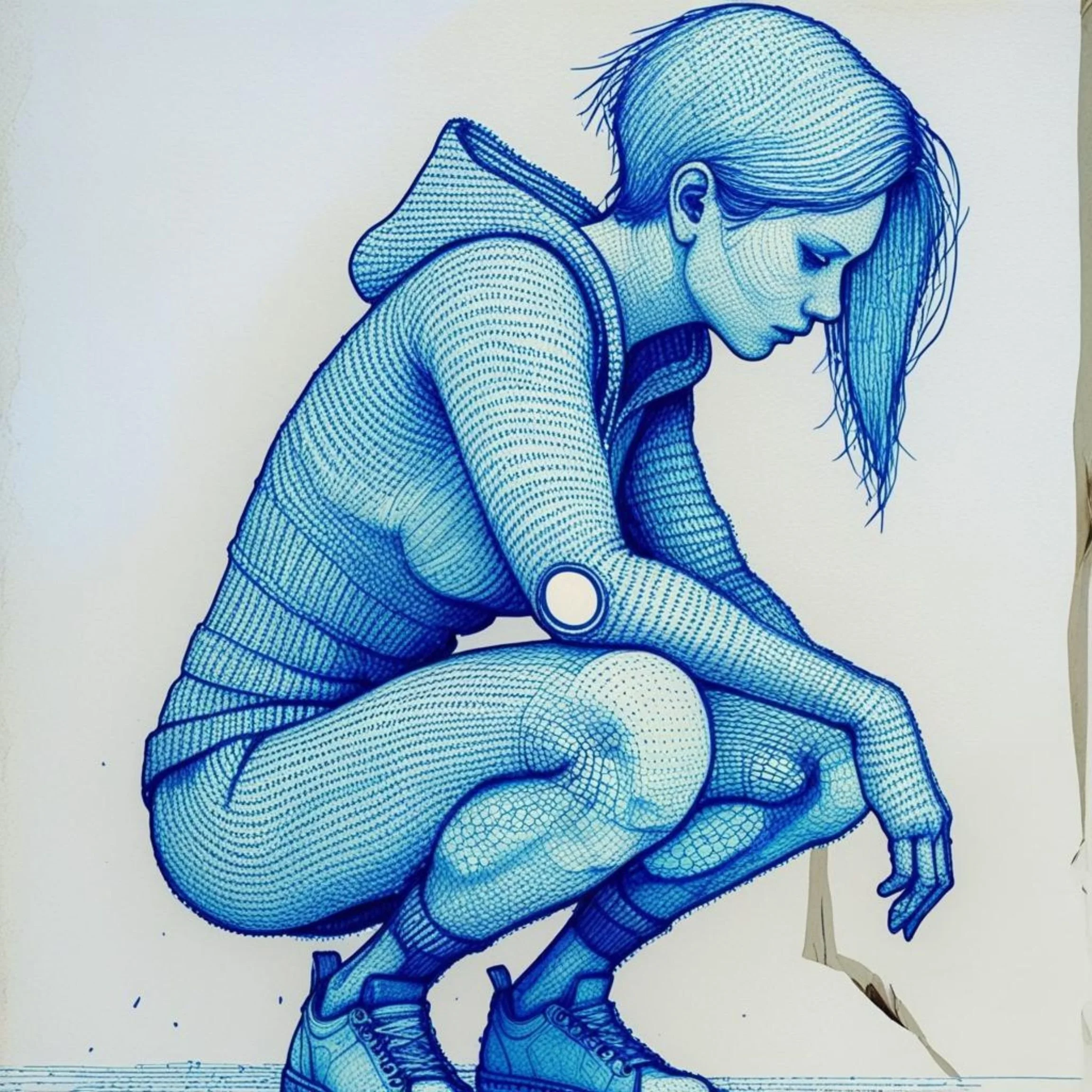



Whereas there are other moments, less tidy, where the decision is already present in the body before I can articulate it. A leaning toward or away. A settling. By the time I say it, it is already true.
This is not a method. I am not reliably good at noticing it.
In fact, I am often in the position of explaining something as though I arrived at it through reasoning, when in retrospect it is clear that the reasoning was assembled afterward. This is mildly embarrassing, in a quiet way.
It is also consistent.
The more I pay attention, the less convincing the separation becomes. Not as an idea — I can still describe the separation very well — but as an actual description of how anything is happening.
There isn’t a clear line where the body ends and the thinking begins.
There are just different speeds.
Sensation is fast. Immediate. It adjusts before it explains. Thought, as language, is slower. It catches up. It arranges what has already occurred into something that can be communicated, including to myself.
This would be a harmonious relationship if the slower part did not keep assuming it was in charge.
There is a quiet comedy in this.
I can feel something shift — a hesitation, a pull, a very specific no — and then watch as a perfectly reasonable explanation appears that has nothing to do with the original signal. It is not even a lie. It is simply unrelated.
The explanation is elegant. The timing is wrong.
I do not take this to mean that the body is always right in a moral or absolute sense. That would be another kind of simplification. But it is precise about itself. It registers conditions as they are, not as I would prefer them to be.
If consciousness is located anywhere, it seems to be located in this entire system, not in one part directing the others.
The brain is included. It is not the container.
Thinking is not something that happens to the body from above. It is something the body is already doing, in multiple forms, only one of which becomes language.
By the time I have the sentence, the thinking is already well underway.
Sometimes finished.
Which does make writing about it slightly awkward.
But only if I insist on starting in the wrong place.