The Wandering Cities
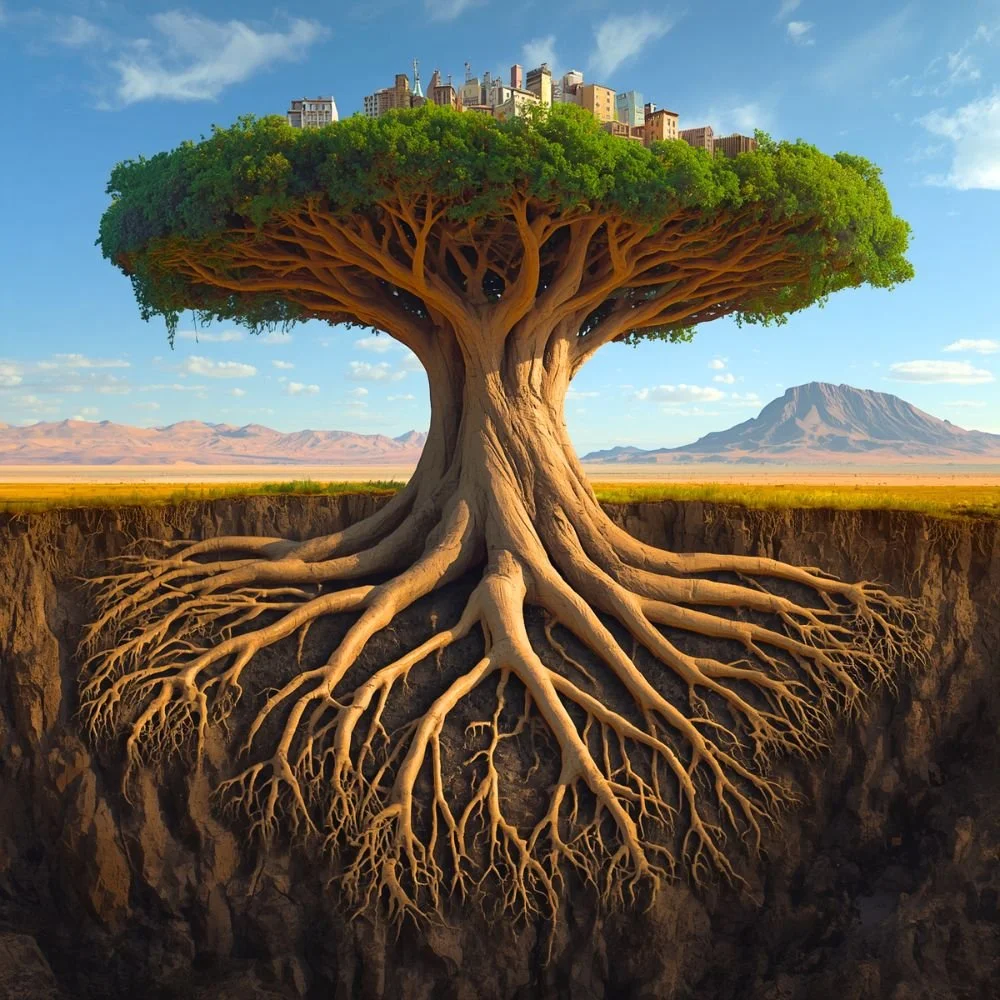
The Wandering Cities
The city arrived at the mountain just after dawn.
The mountain had been there for several million years. The city had not.
Children ran through the streets shouting that it had appeared overnight, although their grandparents remembered seeing it eighty years earlier, the last time the rootway carried them through this part of the Basin.
By midday the upper walkways were crowded. Merchants abandoned their stalls, laundry hung forgotten, and people climbed through the canopy to stare at the dark shape rising beyond the dunes. Some claimed it looked smaller than before. Others insisted it had grown. These arguments accompany nearly every return.
The city itself is built atop one of the great rootways that wander the Basin. Portions of the living structure rise above the sand in ridges and arches broader than roads before diving underground again. Around these exposed roots, generations of residents have added platforms, gardens, homes, cisterns, workshops, stairways, rope bridges, and marketplaces until the entire settlement resembles a travelling grove. From a distance, the canopy can easily be mistaken for a forest, which is particularly surprising because there are no forests within a thousand kilometres.
The rootway moves slowly enough that most residents rarely notice. Days pass. Markets open. Children grow up. Roofs are repaired. Yet every morning the horizon is fractionally different. A ridge shifts a little farther south. A familiar dune settles somewhere unexpected. Some families keep sketchbooks of favourite views in the same way other families keep portraits. Grandchildren grow up comparing mountains they have never seen.
Maps are sold beside calendars. Nobody expects either to remain accurate for very long.
Visitors often become lost because they insist on asking where things are. Locals generally answer with where things are relative to other things. Property deeds describe buildings in relation to neighbouring buildings rather than geography, which is considered far too unreliable for legal purposes. A bakery may remain opposite a dye market for centuries while both drift steadily across the Basin.
The rootway itself does not appear particularly interested in human navigation problems. It is interested in minerals, water, and occasionally things nobody has successfully explained.
One celebrated rootway spent twenty-three years circling a salt basin before resuming its migration. Another diverted hundreds of kilometres westward after encountering a newly exposed seam of copper-rich stone. Nobody in the city was particularly concerned at first. Rootways are known for occasional eccentricities. Concern only began when the root negotiators started appearing in unusually good moods.
Three years later the rootway surfaced directly above one of the richest copper deposits ever found in the Basin.
The negotiators remain impossible to live with.
Most cities employ root negotiators whose job is to influence migration through carefully chosen nutrients, fungal cultures, vibrations, scents, and other methods that vary considerably from city to city. Opinions on negotiators are divided. Botanists often dismiss them. Negotiators point out that botanists are usually standing in the wrong place.
I have spent enough time listening to rootway signalling to be cautious around certainty. The conversations occurring beneath these cities are extraordinarily complex. Some patterns resemble decision-making. Others resemble memory. Still others resemble what can only be described as stubbornness.
One negotiator told me that rootways should be treated less like transportation and more like livestock. A second suggested weather. A third seemed offended by both comparisons. The rootway itself contributed several chemical responses which translated approximately as irritation, though I should admit that the irritation may have been directed at me.
The most anticipated events in the Basin occur when two rootways meet. Nobody knows exactly how these encounters are arranged. Sometimes cities travel together for months. Occasionally for decades. During these periods the canopies merge into a continuous landscape of bridges, gardens, markets, and suspended walkways stretching across the dunes.
The longest recorded convergence lasted twenty-seven years. Children were born, grew up, and reached adulthood believing the neighbouring city was simply another district. Markets merged. Families intermarried. Gardeners exchanged seeds and fungal cultures. Several flowering species spread from one canopy to the other and refused to leave when the cities separated.
When the rootways finally drifted apart, residents continued arguing for decades over which city had invented particular recipes, songs, and varieties of fruit. People speak of future convergences the way sailors once spoke of distant ports. They know the reunion will come. They simply do not know when.
I am often asked where these cities are going. The question assumes a destination.
After many years listening to rootway signals, I am no longer convinced that destinations are the point.
The mountain the city reached this spring was not new. The copper seam was not new. The salt basin had been there all along. Perhaps migration is not about finding things so much as revisiting them. The children who climbed into the canopy that morning believed they had discovered a mountain. Their grandparents knew otherwise. The rootway knew otherwise too.
It had simply decided it was time to visit an old acquaintance again.