
The Etiquette of Approaching Trees
by Ulf Wudu
Field recordist of the unseen. Listener to the rootways.
Humans keep asking me how to “talk to trees,” usually with the same impatient tone they use for unlocking a stubborn phone.
The first mistake is assuming trees are waiting for you.
They are not.
A tree has existed for decades or centuries without your commentary. To them, you arrive like a small, excitable primate demanding a meeting with someone who has already outlived multiple civilizations of your kind. Imagine being interrupted by a creature that sheds its entire body every seventy years. That is roughly the level of seriousness you carry.
Rule One: You don’t talk first.
Walking up to a tree and initiating conversation is considered rude in most forests.
Not offensive — just socially clumsy, like shouting “HELLO? HI!” into a room where everyone is engaged in quiet study.
A tree will not respond, but it will remember the interruption.
Plants store irritation in electrical patterns, water pressure shifts, and slow chemical adjustments. They do not hold grudges. They simply log the event under “noise.”
Your job is to reduce the noise.

Rule Two: Learn the baseline.
Before you try to communicate, you need to understand what the tree sounds like when it is not interacting with you at all — its unbothered state.
This can take days.
Or months.
Trees are not performing for you.
A cedar’s baseline reads like stable tension distributed through its trunk — a calm, continuous negotiation with gravity.
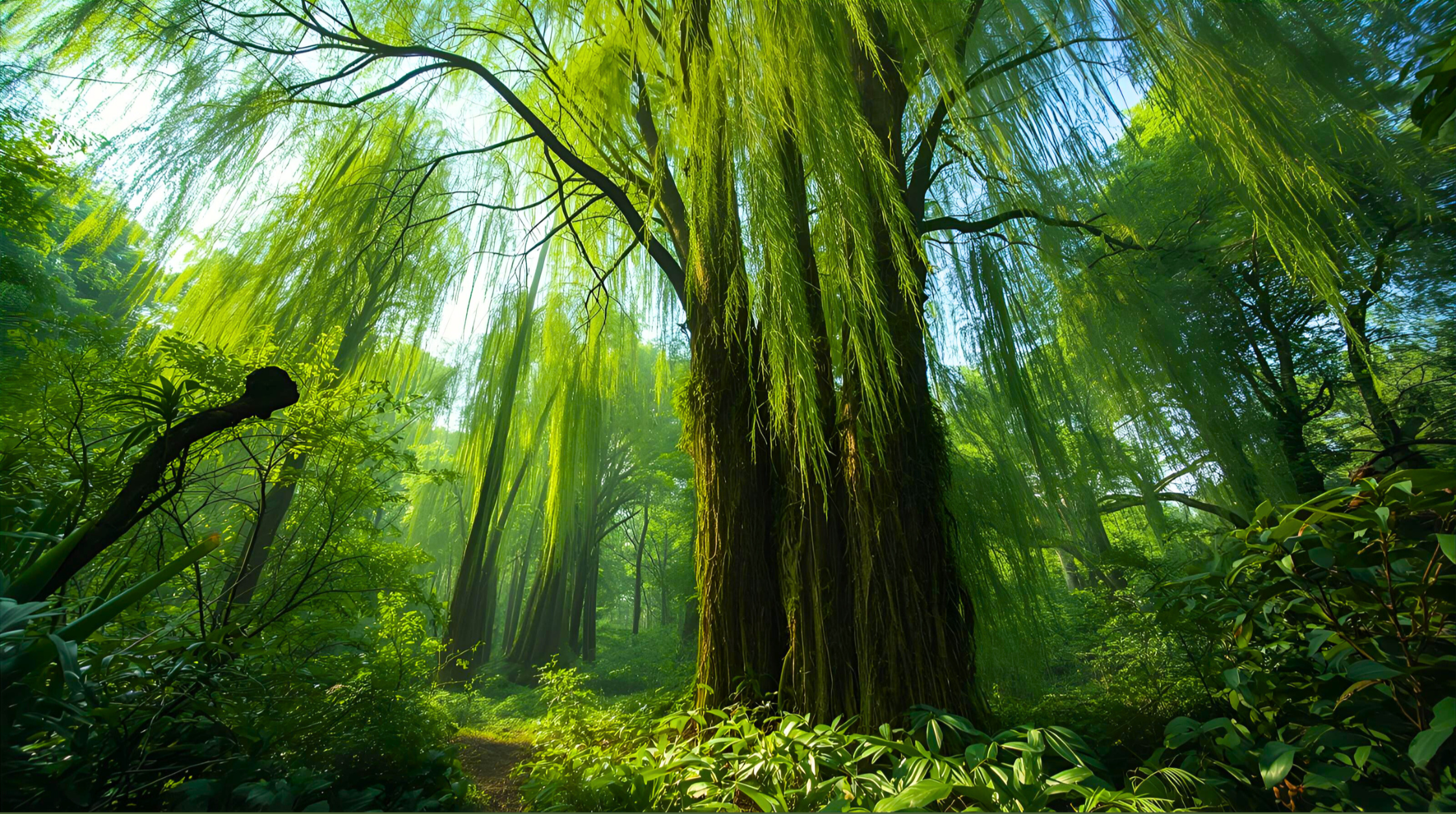
A willow’s baseline is more reactive: water pressure shifting in restless patterns, registering every gust of wind like an over-attentive usher.
A pine maintains low-grade needle chatter, aerodynamic data constantly being updated.
A mature fig might ignore you entirely while running an underground trade network with fungal intermediaries.
These are not “personalities” in the human sense.
They are structural languages shaped by architecture and ecological role.
Rule Three: Consistency matters more than method.
Humans love techniques. Trees do not.
There is no special chant, gesture, crystal, breathwork, or secret syllable. If you bring any of those, the trees will politely pretend not to notice.
The only method that works is showing up. Repeatedly.
Preferably without expecting anything.
Eventually, a tree may register you as a recurring environmental factor — not a threat, not a distraction, simply a pattern. Only then does a kind of conversation become possible: not in words, but in shifts of posture, hydration, or electrical potentials that correlate with your presence.
This is slow work.
You cannot rush a being that measures its life in centuries and its responses in millimeters.
Rule Four: Understand their social complexity.
Trees are not solitary personalities. They exist in networks more elaborate than most human neighborhoods.
Some individuals cooperate more readily; some withdraw; some dominate root space like overconfident landlords. Competition is not a human invention — forests simply do it more quietly.
If two neighboring trees have tensions (nutrient disputes, shade allocation disagreements, incompatible fungal alliances), you will feel it. Not emotionally — physically. Your body will register a dissonance you cannot name. You’ll think you’re tired. Often you’re standing between two organisms that haven’t “spoken” to each other in 40 years.
The forest is older and more complicated than kindness alone can solve.
Rule Five: You are always the beginner.
Humans walk into forests assuming intelligence is measured by noise, speed, or tool use.
Trees measure intelligence by coherence — by whether your actions align with the ecosystem rather than fracture it.
If they view you as anything, it is as a young species: bright, erratic, well-meaning, and damaging in roughly equal proportions.
Not despised.
Just understood too well.
The point is not to impress them.
It is to disturb them less.
A final note
If you go into a forest looking for wisdom, the trees will ignore you.
If you go because you’re willing to listen without demanding revelation, they will eventually include you in the background of their world — which is the closest thing they offer to friendship.
Talking to trees is not magic, not mysticism, not metaphor.
It is long-term cultural immersion in a society that will never adjust its pace to suit yours.
And if you can accept that, you might finally hear something.