We Left the Ocean, But It Never Left Us
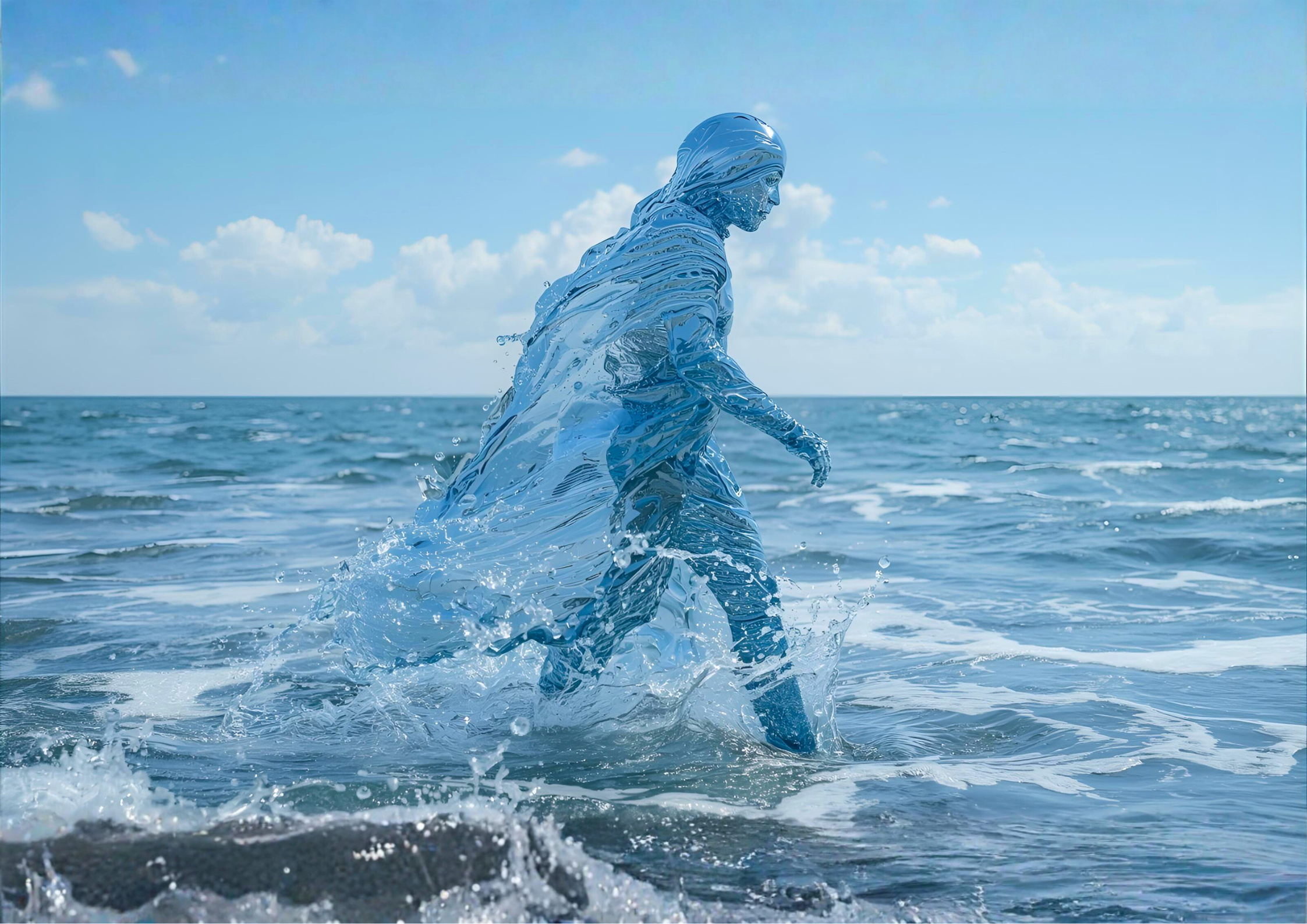
We Left the Ocean, But It Never Left Us
by Ozzy Annoa
Humans claim they left the ocean. Technically, they only changed containers.
You walk around upright, confident in your terrestrial credentials, while carrying the sea inside your tissues with almost touching loyalty. The body is not a departure from water but a portable version of it—held, warmed, pressurized, and kept in motion so the chemistry doesn’t stall.
Blood plasma still carries the ionic signature of ancestral seas: sodium, chloride, potassium, calcium. Not in the exact ratios of any modern shoreline, but close enough to expose the origin. Enzymes require water to fold and function; electrical signaling depends on dissolved ions; cells are nothing but constrained volumes of fluid negotiating their membranes. From a biochemical perspective, you are not land creatures. You are marine entities executing a long experiment in verticality.
Before you face the world, you float in a controlled saline environment. Amniotic fluid is not metaphorical ocean—it is literally water, electrolytes, proteins, and the suspended materials required for development. Early embryonic processes operate using genetic pathways inherited from aquatic ancestors. None of this is romantic. It is simply continuity.
Even after birth, the internal hydrosphere governs everything. Blood pressure is an ongoing negotiation with gravity. Lymph moves more slowly, carrying what circulation leaves behind. Hormones and circadian molecules shift in measured oscillations. These are tides, but not poetic ones—pressure gradients, chemical pulses, feedback cycles. When your mood changes, nothing mystical occurs. The composition of the internal ocean shifts, and perception adjusts with it.
Skin enforces a temporary boundary. It slows water loss, but never fully prevents it. Salt leaves through sweat, moisture evaporates, and the body responds by reallocating fluid so the internal environment does not slide toward failure. Dehydration is not inconvenience; it is an existential threat. Organisms built on dissolved chemistry do not survive without the solvent. Dryness is system collapse.
Your personal ocean and the planet’s are not independent. Both operate through the same physical principles: hydrogen bonding, thermal buffering, solvent power, the capacity to host reactions. Even your breath depends on water vapor to move efficiently through air. The boundary between internal and external hydrospheres is more administrative than real.
You did not leave the ocean. You internalized its conditions and call the result autonomy. But every time your body recalibrates its fluids to keep you alive on land, it reveals the truth: you are still submerged, just not visibly.